#include <fdv2_data_system.hpp>
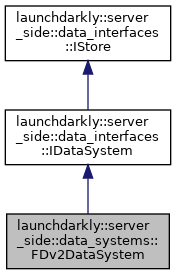
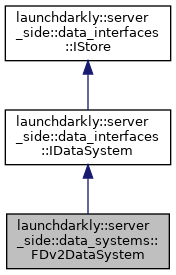
Public Member Functions | |
| FDv2DataSystem (std::vector< std::unique_ptr< data_interfaces::IFDv2InitializerFactory >> initializer_factories, std::vector< std::unique_ptr< data_interfaces::IFDv2SynchronizerFactory >> synchronizer_factories, std::unique_ptr< data_interfaces::IFDv2ConditionFactory > fallback_condition_factory, std::unique_ptr< data_interfaces::IFDv2ConditionFactory > recovery_condition_factory, boost::asio::any_io_executor ioc, data_components::DataSourceStatusManager *status_manager, Logger const &logger) | |
| FDv2DataSystem (FDv2DataSystem const &)=delete | |
| FDv2DataSystem (FDv2DataSystem &&)=delete | |
| FDv2DataSystem & | operator= (FDv2DataSystem const &)=delete |
| FDv2DataSystem & | operator= (FDv2DataSystem &&)=delete |
| std::shared_ptr< data_model::FlagDescriptor > | GetFlag (std::string const &key) const override |
| std::shared_ptr< data_model::SegmentDescriptor > | GetSegment (std::string const &key) const override |
| std::unordered_map< std::string, std::shared_ptr< data_model::FlagDescriptor > > | AllFlags () const override |
| std::unordered_map< std::string, std::shared_ptr< data_model::SegmentDescriptor > > | AllSegments () const override |
| std::string const & | Identity () const override |
| void | Initialize () override |
| bool | Initialized () const override |
 Public Member Functions inherited from launchdarkly::server_side::data_interfaces::IDataSystem Public Member Functions inherited from launchdarkly::server_side::data_interfaces::IDataSystem | |
| IDataSystem (IDataSystem const &item)=delete | |
| IDataSystem (IDataSystem &&item)=delete | |
| IDataSystem & | operator= (IDataSystem const &)=delete |
| IDataSystem & | operator= (IDataSystem &&)=delete |
| Public Member Functions inherited from launchdarkly::server_side::data_interfaces::IStore | |
| IStore (IStore const &item)=delete | |
| IStore (IStore &&item)=delete | |
| IStore & | operator= (IStore const &)=delete |
| IStore & | operator= (IStore &&)=delete |
Detailed Description
FDv2DataSystem is the IDataSystem implementation for the FDv2 protocol. It runs a sequence of initializers to populate an in-memory store, then hands off to a synchronizer for ongoing updates.
Lifecycle / call order:
- Construct.
- Call Initialize() exactly once. It returns immediately; orchestration runs asynchronously on the executor.
- Call IStore methods (GetFlag/GetSegment/AllFlags/AllSegments) and Initialized() / Identity() any number of times, from any thread.
- Drain the executor and join callers (see Destruction protocol).
- Destroy.
Initialize() may not be called more than once.
Thread safety:
- GetFlag, GetSegment, AllFlags, AllSegments, Initialized, and Identity are safe to call concurrently from any thread.
- Initialize() is intended to be called once from a single thread.
- The destructor must run with no other method calls in flight; see Destruction protocol below.
Destruction protocol:
The destructor cancels in-flight orchestration (closes the active source) but does NOT block to drain executor callbacks that may already be queued. Before destroying, the caller must ensure both of:
- The executor that orchestration callbacks run on has been stopped AND any thread running it has been joined. Otherwise a previously- scheduled callback may run and reference a destroyed object.
- No other thread is currently calling a method on this object.
The standard pattern is:
ioc.stop();          // no new callbacks; running work returns
run_thread.join();   // wait for the executor thread to exit
// Now no thread can be touching this object.
// Destroy FDv2DataSystem.
ClientImpl's destructor uses this pattern (~ClientImpl performs ioc_.stop() and run_thread_.join() before any member is destroyed).
Sources (initializers and synchronizers):
Sources are constructed lazily via the factories supplied at construction. Each factory is invoked at most once during a run of the orchestration. A source is closed and destroyed when the orchestration finishes processing a result that ends its turn, or when the FDv2DataSystem is destroyed. At any given moment at most one source is active.
Selector tracking:
FDv2DataSystem tracks the most-recent non-empty selector seen on a ChangeSet and passes it into each subsequent synchronizer Next() call. The initial selector is empty.
Orchestration phases:
      Initialize()
          |
          v
+-------------------+   no factories given
|  Offline?         |---------> [Done, status = kValid]
+-------------------+
          |
          v
+-------------------+    initializer #N returns:
|  Initializer phase|      ChangeSet(no selector) -> stay, N += 1
|  N = 0, 1, 2, ... |      ChangeSet(selector)    -> go to Sync
|                   |      Interrupted/Terminal   -> stay, N += 1
|                   |      Goodbye                -> stay, N += 1
|                   |      Shutdown               -> [Closed]
+-------------------+
          |
          | (N exhausted, or basis received)
          v
+-------------------+    active synchronizer's Next returns:
|  Synchronizer     |      ChangeSet      -> apply, loop
|  phase            |      Interrupted    -> loop (source self-retries)
|  (cyclic;         |      Goodbye        -> loop (source self-restarts)
|   blocked sources |      TerminalError  -> block, advance
|   are skipped)    |      Shutdown       -> [Closed]
+-------------------+
              ^   |     fallback condition  -> advance (with wrap)
              |   |     recovery condition  -> reset to first available
              +---+
          |
          | (all synchronizers blocked)
          v
[Done; final status preserved]
Status transitions:
kInitializing (initial) -> kValid on first successful ChangeSet apply. kInterrupted on Interrupted / TerminalError (filtered to kInitializing while still in the initializer phase if not yet Valid). kOff if all initializers exhaust without data and no synchronizers are configured. kValid -> kInterrupted on errors; kOff when synchronizers cycle through and exhaust. kInterrupted -> kValid on next successful ChangeSet apply; kOff on synchronizer exhaustion. kOff -> terminal.
Constructor & Destructor Documentation
◆ FDv2DataSystem()
| launchdarkly::server_side::data_systems::FDv2DataSystem::FDv2DataSystem | ( | std::vector< std::unique_ptr< data_interfaces::IFDv2InitializerFactory >> | initializer_factories, |
| std::vector< std::unique_ptr< data_interfaces::IFDv2SynchronizerFactory >> | synchronizer_factories, | ||
| std::unique_ptr< data_interfaces::IFDv2ConditionFactory > | fallback_condition_factory, | ||
| std::unique_ptr< data_interfaces::IFDv2ConditionFactory > | recovery_condition_factory, | ||
| boost::asio::any_io_executor | ioc, | ||
| data_components::DataSourceStatusManager * | status_manager, | ||
| Logger const & | logger | ||
| ) |
Constructs the data system.
- Parameters
-
initializer_factories Factories that build initializers, run in order during the initialization phase. synchronizer_factories Factories that build synchronizers, used in order for ongoing updates after initialization. fallback_condition_factory Factory for the per-synchronizer fallback condition. May be null. If null, fallback transitions are never triggered; synchronizers only rotate on terminal errors. recovery_condition_factory Factory for the per-synchronizer recovery condition. May be null. If null, the orchestrator does not return to a more-preferred synchronizer once it has fallen back. ioc Executor on which orchestration callbacks run. status_manager Non-owning. Must outlive this object; the caller is responsible for ensuring this. Used to publish data-source status transitions. logger Used for diagnostic logging. Held by value (Logger is internally thread-safe and cheap to copy).
Member Function Documentation
◆ AllFlags()
|
overridevirtual |
Returns all flag descriptors currently in the store, keyed by flag key. The returned map is a snapshot; subsequent updates are not reflected.
Implements launchdarkly::server_side::data_interfaces::IStore.
◆ AllSegments()
|
overridevirtual |
Returns all segment descriptors currently in the store, keyed by segment key. The returned map is a snapshot; subsequent updates are not reflected.
Implements launchdarkly::server_side::data_interfaces::IStore.
◆ GetFlag()
|
overridevirtual |
Returns the flag descriptor for the given key, or nullptr if no flag with that key is currently in the store.
Implements launchdarkly::server_side::data_interfaces::IStore.
◆ GetSegment()
|
overridevirtual |
Returns the segment descriptor for the given key, or nullptr if no segment with that key is currently in the store.
Implements launchdarkly::server_side::data_interfaces::IStore.
◆ Identity()
|
overridevirtual |
Returns a display-suitable name for the data system, used in diagnostic logging.
Implements launchdarkly::server_side::data_interfaces::IDataSystem.
◆ Initialize()
|
overridevirtual |
Starts the orchestration: runs initializers in order on the executor, then hands off to a synchronizer for ongoing updates. Returns immediately; orchestration runs asynchronously. Must be called exactly once, before any IStore method is invoked.
Implements launchdarkly::server_side::data_interfaces::IDataSystem.
◆ Initialized()
|
overridevirtual |
Returns true once the in-memory store has been populated for the first time. Naming follows the IDataSystem base interface (predates the IsX() convention).
Implements launchdarkly::server_side::data_interfaces::IStore.
The documentation for this class was generated from the following files:
- src/data_systems/fdv2/fdv2_data_system.hpp
- src/data_systems/fdv2/fdv2_data_system.cpp